
Mahrokh Saberi's Zissa Scar Story
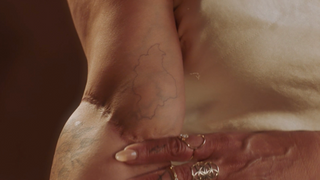
Mahrokh is a hair stylist. She has a scar that runs the length of her arm.
She was six.
Her family was leaving Iran, traveling through Istanbul on a short stop to finalize their immigration papers for America. A short trip turned into a long stay.
She was playing in the hotel lobby with two other kids. They had been told not to use the elevator. Mahrokh decided to take it upon herself.
The three of them got into the elevator with a small ball. The ball rolled into a gap. The elevator was old — no sensors, no safety mechanisms. As it began to climb from the ground floor, Mahrokh reached in to grab the ball.
Her arm got jammed in the space.
They had to power down the entire building and manually crank the elevator up to the service level to get her out. There were no paramedics. No ambulances. No first aid. Just civilians in a hotel lobby. Her father broke the elevator door open to pry her free.
They wrapped her in hotel sheets, threw her into a taxi, and drove to the nearest hospital.
She was Persian. Her family spoke Farsi. They were in Turkey. They didn't speak Turkish.
A man at the hospital — Mahrokh speaks of him like a guardian angel — happened to speak every language they needed. He rode with them to the hospital. There happened to be an American doctor on call that day. Between the two of them, they put her arm back together over a thirteen-hour reconstructive surgery.
The first time she saw the scar, she was at her grandmother's house.
She had been bandaged for a long time. She knew the inside of her arm but hadn't yet seen the back. She remembers exactly where she was standing in her grandmother's house when she walked up to the mirror and held her arm out.
"I was just beyond terrified."
She didn't want to look at it again. It took her mother twenty years to be able to look at it.
In high school, her friends would tell her to stop covering it. Even when she played sports, she'd wear long sleeves or rig sleeves out of fabric to hide it. Her friends gave her the confidence to leave it uncovered sometimes — but it kept affecting her in ways she didn't always name.
It wasn't until her early forties that something shifted.
"I decided to truly embrace the woman I'm becoming. Confident in my career and in myself."
She started getting tattoos. She'd never had any before. People asked her why she was only getting them on one arm.
"I'd like to see them. It's me. It's my story. And it adds to my scar."
The tattoos became a way of decorating what she had spent decades hiding. The scar wasn't something to cover. It was the canvas.
When we sent Mahrokh a Zissa scar sheet, she immediately saw it as part of the same project.
"I'm not done with my tattoos. With Zissa, I can create more art and have more fun and embrace my scar even more than I ever have."
She found that she could cut the silicone into different shapes — wear different versions on different days. Treat protection as styling.
"The silicone sheet can be cut in various shapes, so it can be used as body art and protection. It's a win-win."
She works with her arms all day. She bends her elbow constantly. She's exposed to sun. The Zissa sheet keeps the scar protected and the moisture in while she keeps cutting hair, keeps creating, keeps moving.
"It gives me the mobility I need and the protection I need. As a creative artist, I need that flexibility. It provides protection and yet it's fashionable and fun. Ten out of ten."
Mahrokh's Advice for Someone Earlier in the Journey
"Embrace every stage of it. Go through every emotion — the hurt, the laughter, the cries. Embrace it all because it's your story. It has everything to do with your journey. If you embrace it, you make it easier for the next person to embrace theirs. We mirror each other. The moment I stopped hiding my scar is when I started truly embracing the person I'm becoming."
Zissa Scar Stories is an ongoing series featuring people who are reshaping their relationship with their scars. If you'd like to share yours, reach out.

